
What Rural Hospitals Actually Need for Interoperability
The $50B is flowing and September's deadline looms. Rural hospitals don't need another framework — they need tools that work today.
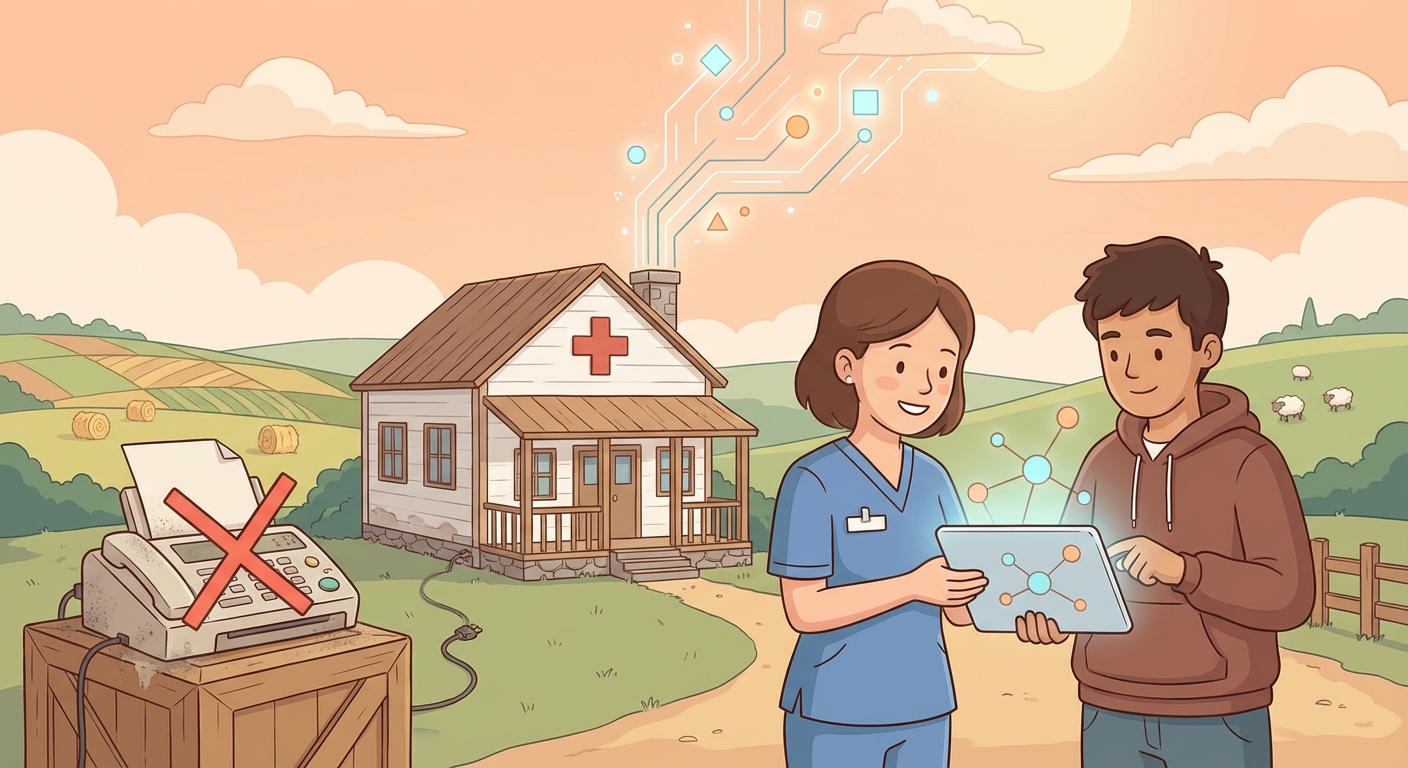
This week, Rhode Island became one of the first states to show exactly where Rural Health Transformation Program dollars are going. Of the $32.9 million Governor McKee allocated, $16.7 million is earmarked specifically for health IT interoperability. Not "innovation labs." Not "digital strategy roadmaps." Interoperability.
That's the signal. The $50 billion CMS committed to rural health modernization isn't theoretical anymore. States are writing checks, and interoperability is where the money is landing.
The Fax Paradox
The same week Rhode Island announced its allocation, MedCity News published a piece that should be required reading for anyone building health IT solutions. Denis Whelan, CEO of Documo, described what he calls the "fax paradox": one radiology leader processes 3 million monthly faxes compared to just 3,000 secure digital messages.
Three million versus three thousand. That's the gap.
Whelan's warning is blunt: rural health organizations "cannot afford to get dazzled by AI demo candy." More than 40% of rural hospitals operate at a loss. 417 facilities are vulnerable to closure. These organizations don't need a pitch deck about generative AI transforming their workflows. They need their referral faxes to become structured data.
The September Clock
Here's what makes the next five months urgent. CMS will conduct its first Year 1 performance review of RHTP-funded states in September 2026. States need to demonstrate measurable results — not just strategic plans, but evidence that funded initiatives are delivering patient care improvements.
Mark Dumoff of ReviveHealth puts it plainly: "Rural America doesn't need another framework. It needs care by September."
For health IT, that means the window for deploying interoperability infrastructure is now. Not next quarter. Not after the next strategic planning cycle. Solutions that can be stood up in weeks — not months — have an advantage that no feature list can match.
Three Tiers of Reality
HealthTech Magazine published a useful framework for rural health IT priorities this week, based on CDW healthcare strategists' analysis:
Short-term (now): Infrastructure stabilization, cyber risk reduction, and AI-enabled clinical documentation. These are the fires that need to be put out before anything else can work.
Medium-term (6-18 months): Migration from fragmented systems to consolidated EHR and cloud platforms. This is where interoperability tools earn their keep — bridging legacy systems to modern APIs without rip-and-replace projects.
Long-term (18+ months): Scalable telehealth, remote patient monitoring, and AI-driven analytics for chronic disease management.
The medium-term tier is where the real opportunity lives. Rural facilities running five different systems across three locations don't need to replace everything. They need a translation layer that makes those systems talk to each other in a common language.
The Unsexy Foundation
At HIMSS26 in March, rural health moved from a side conversation to a main-stage theme. CMS Administrator Dr. Oz emphasized that "technology-enabled care models, including telehealth and digital platforms" are essential where traditional staffing models don't work.
That's the right framing. But the presentations that draw crowds at HIMSS — AI copilots, ambient listening, predictive analytics — all depend on something less glamorous: standardized terminology.
When a rural hospital sends a medication list to a specialist two counties over, the receiving system needs to understand what each drug is. That means NDC codes that resolve to actual products. RxNorm concepts that enable interaction checking. LOINC codes on lab results so they populate the right fields. ICD-10 codes specific enough for clinical decision support to function.
This is the plumbing. It doesn't make keynote slides. But without it, the AI copilot hallucinates, the telehealth platform shows garbage data, and the population health dashboard is meaningless.
What "Just Works" Looks Like
Rural facilities have zero to two IT staff. They can't run a terminology server. They can't maintain crosswalk tables. They can't debug FHIR mapping pipelines at 2 AM when the on-call clinician needs drug interaction data.
What they need is infrastructure that works like a utility:
- API-based terminology resolution — send a code, get back a standardized result. No local installation. No maintenance burden.
- Daily-updated data — code systems change constantly (new NDC packages, updated ICD-10 codes, revised LOINC panels). Stale data means wrong answers.
- Cross-system translation — a drug code from one EHR needs to map to the equivalent in another. An ICD-10 code needs to resolve to its HCC category for risk adjustment. A SNOMED concept needs its ICD-10 crosswalk.
- Lightweight integration — a single API call, not a platform migration. Something a developer can wire up in an afternoon, not a consultant engagement that takes six months.
Yesterday, CMS announced its 7th Annual FHIR Connectathon for July 14-16. The theme is real-world operationalization of FHIR-based solutions. The emphasis on "operationalized in real-world systems" — not "demonstrated in a lab" — reflects where the industry is heading. Theory time is over.
Key Takeaways
- The money is real and flowing now. Rhode Island's $16.7M allocation for health IT interoperability is a leading indicator. Every state has RHTP funding, and interoperability is a scored priority.
- September 2026 is the first checkpoint. States must show measurable results, not just plans. Rapid-deploy solutions have a structural advantage.
- 417 rural hospitals are vulnerable to closure. These facilities need practical tools, not enterprise-scale platforms. Zero IT staff means zero tolerance for complexity.
- Terminology is the foundation everything else depends on. AI, telehealth, population health, and value-based care all break down without standardized clinical coding.
- The fax machine is still winning. Three million faxes versus three thousand secure messages. Closing that gap is the real interoperability challenge — and the real opportunity.
Further Reading
- CMS Rural Health Transformation Program Overview — official program page with state award details
- CMS 7th Annual FHIR Connectathon Announcement — July 14-16, 2026 (virtual)
- $50B for Rural Health IT: What Developers Need to Know — our deep dive on the program details and state-level proposals
- FHIRfly Rural Health Solutions — how terminology APIs support rural interoperability
Build it on real terminology
Try any endpoint live — no sign-up required.